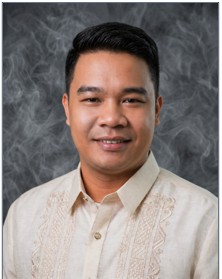
By Mr. Jess M. Domigan, RCrim | CCJE Crime Laboratory Custodian, Baguio Central University | April 2026
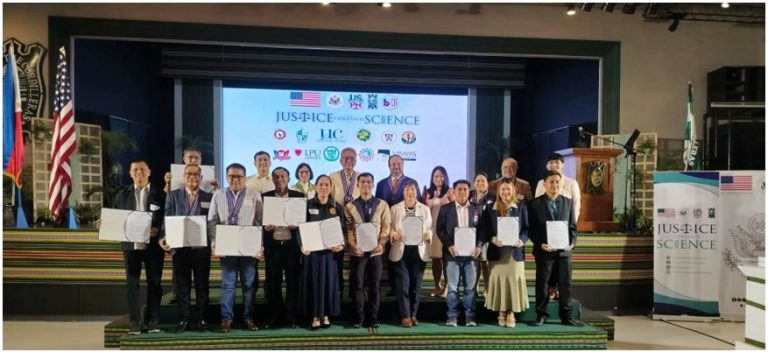
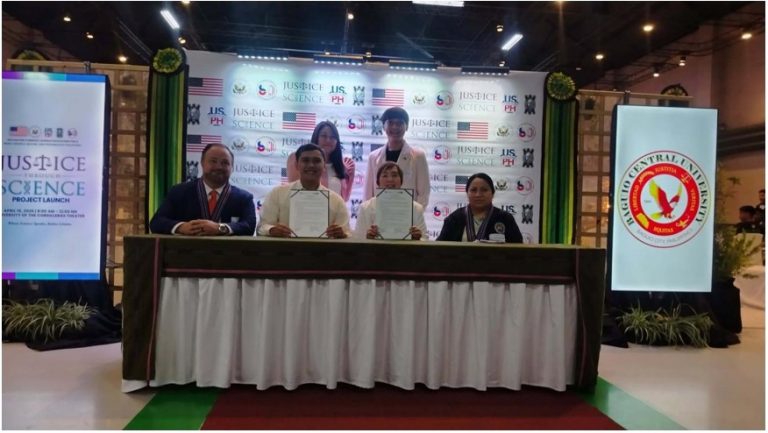
Baguio Central University’s College of Criminal Justice Education has formalized its role in a landmark forensic science initiative, becoming a partner institution in the “Justice Through Science” project. It is a collaborative effort backed by the U.S. Department of State and timed to mark 80 years of Philippine-American diplomatic relations. The Memorandum of Agreement was signed on April 16, 2026 at the University of the Cordilleras, bringing together academic institutions, law enforcement agencies, and international partners in a shared commitment to strengthen forensic science capabilities across the Philippines.
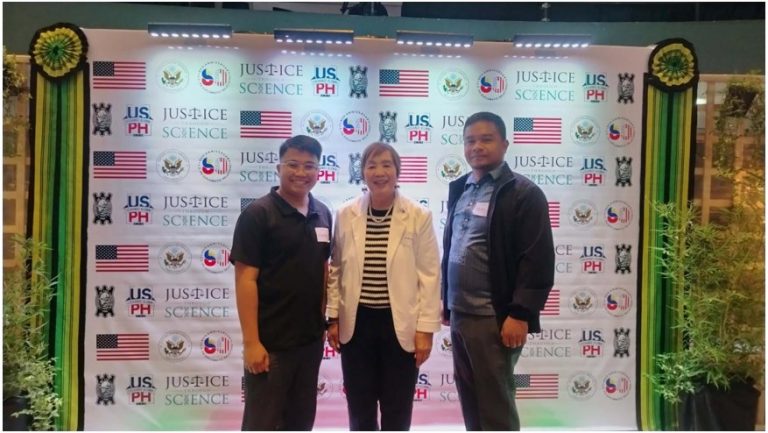
BCU CCJE was represented at the launch event by Vice President for Academic Affairs Dr. Elma Donaal, Mr. Jess M. Domigan, and Mr. Norman B. Bustillo, under the leadership of OIC Dean Beca May Palitayan. Their presence at the signing underscored BCU’s active stake in advancing forensic education. It is as an institutional obligation, but as a contribution to a justice system that serves every Filipino.
The project is a collaborative undertaking among the U.S. Department of State, the U.S. Embassy in the Philippines, the University of the Cordilleras, and the U.S. International Exchange Alumni–Philippines. Its launch coincides with the celebration of eight decades of Philippine-American diplomatic relations, anchoring the initiative within a broader narrative of international cooperation in the pursuit of justice and institutional integrity.
Speaking on behalf of the host institution, Ray Dean D. Salvosa, Chairman of the Board of Trustees of the University of the Cordilleras, emphasized that forensic science is not ancillary to justice — it is foundational to it. Scientific methods strengthen evidentiary value and uphold the integrity of legal proceedings by ensuring accuracy and objectivity in case resolution.
The keynote address was delivered by Rodil V. Zalameda, Associate Justice of the Supreme Court of the Philippines, who articulated with particular force the indispensable role of forensic science in the fair administration of justice. As legal systems evolve, he stressed, the integration of scientific expertise is not optional. It is essential to establishing truth and accountability in a court of law.
The U.S. Embassy in the Philippines, through a message delivered by Chad Kinnear, reaffirmed its commitment to partnerships that advance justice, transparency, and the rule of law through scientific progress — a commitment that both nations have sustained across eight decades of bilateral cooperation.
At the heart of the Justice Through Science project is a comprehensive training program designed to elevate the competencies of students and practitioners in the forensic field. The curriculum combines specialized online instruction with intensive, hands-on laboratory training across three core disciplines: forensic anthropology, friction ridge examination (fingerprint analysis), and DNA analysis, three tools that have exonerated the innocent and identified the guilty in courts around the world.
To ensure nationwide reach, the project will conduct a seminar series anchored at three strategic sites: the University of the Cordilleras for Luzon, the University of Cebu, Inc. for the Visayas, and PHINMA-Cagayan de Oro College for Mindanao. A series of webinars featuring local and international forensic science practitioners will run in parallel, fostering knowledge exchange and strengthening professional networks across the archipelago.
The program is open to educators, law enforcement personnel, legal professionals, and forensic science practitioners. Applications for the online training component were accepted until April 30, 2026.
Beyond technical training, the initiative carries a civic dimension: to raise public awareness of forensic science as a pillar of the Philippine justice system. By bridging the distance between science and law, it promotes evidence-based practice that makes justice not only possible but verifiable.
For BCU CCJE, participation in Justice Through Science is a statement of institutional purpose. Forensic education at its best does not merely train technicians. It forms men and women who understand that a correct laboratory result can mean the difference between wrongful imprisonment and freedom, between a crime solved and a perpetrator who walks free. As the Philippines continues to strengthen its justice framework, initiatives like this one demonstrate what becomes possible when education, diplomacy, and science converge in service of a shared human value: that truth matters, and that the tools to find it must be placed in capable, ethical hands.
“It is evidence that does not forget. It is not confused by the excitement of the moment. It is not absent because human witnesses are. It is factual evidence. Physical evidence cannot be wrong, it cannot perjure itself, it cannot be wholly absent. Only human failure to find it, study and understand it, can diminish its value.”
— Edmund Locard (a pioneering French criminologist and forensic scientist known as the “Sherlock Holmes of France)
Photo credits: Mr. Norman B. Bustillo, RCrim (CCJE Full-Time Faculty)
About the Author:
Mr. Jess M Domigan is currently the Laboratory Custodian at Baguio Central University and is highly motivated to further develop his career by acquiring more knowledge in the field of forensic science, enabling him to teach his students more effectively.