By Genevieve B. Kupang
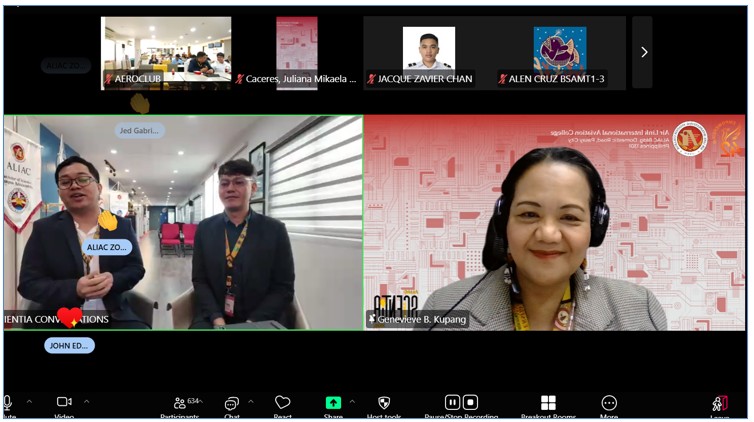
On June 18, 2026, Air Link International Aviation College (ALIAC) opened its virtual doors to more than 680 participants for the Scientia Knowledge Hub Convention 2026, held online via Zoom. Themed “Train. Sustain. Explain: Artificial Intelligence for Smarter Skies,” the full-day convention brought together compelling voices in aviation education, institutional leadership, AI integration, gender equity, and peace education. It was, by every measure, a day worth remembering
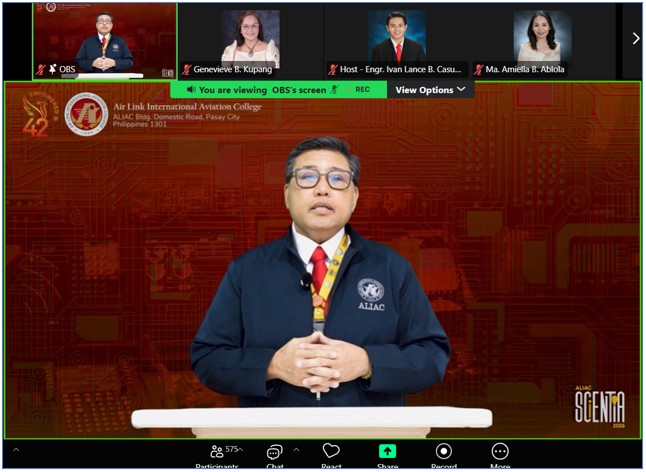
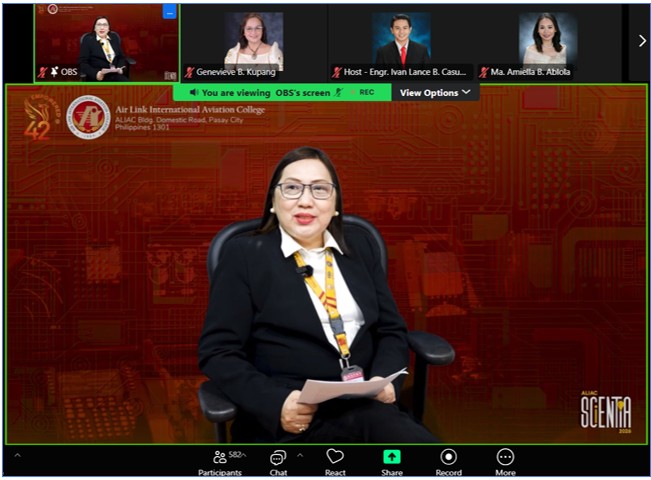
The convention opened at nine in the morning under the stewardship of Masters of Ceremonies Engr. Ivan Lance Casupang and Ms. Ma. Amiella Agpaoa Ablola. Atty. Gomeriano Amurao, ALIAC’s President and CEO, welcomed participants with opening remarks affirming the institution’s commitment to forward-looking aviation education, while Dr. Lina Constante, Vice President for Academic Affairs, set the intellectual tone with a crisp introduction to Scientia’s history and vision.
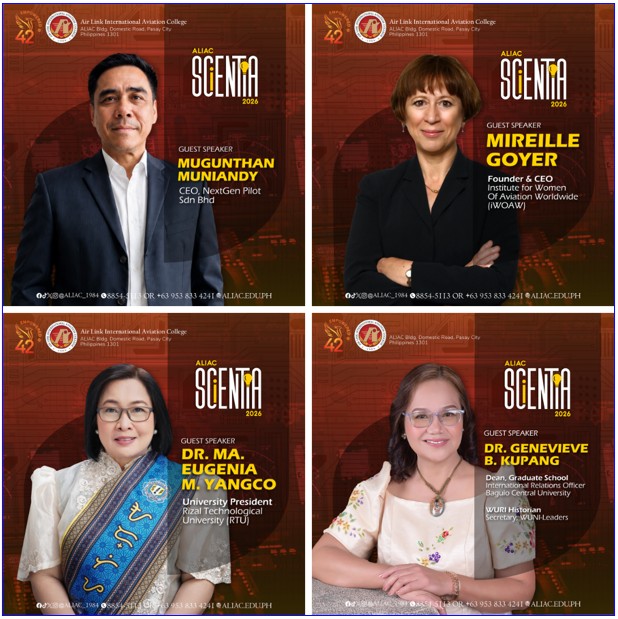
Mugunthan Muniandy: The AI-Ready Aviator
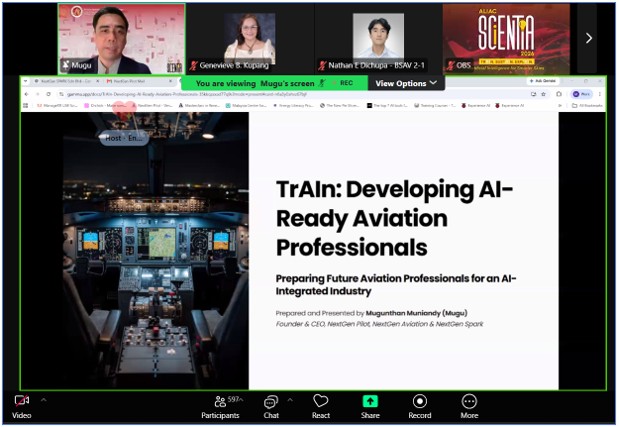
The first plenary session belonged to Mr. Mugunthan Muniandy, known as Mugu, Founder and CEO of NextGen Pilot Sdn Bhd in Malaysia. His presentation, “TrAIn: Developing AI-Ready Aviation Professionals,” was a masterclass in balancing enthusiasm for technology with respect for human judgment.
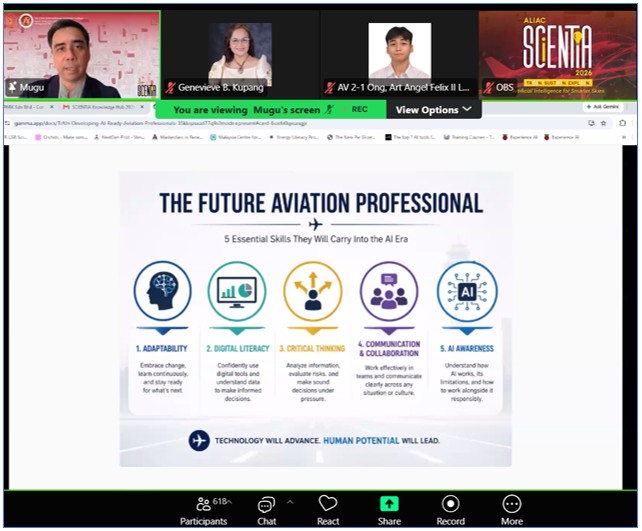
Mugu opened with a statement that few could dispute: AI is already in aviation. It powers adaptive pilot training, predictive maintenance, fuel optimization, crew scheduling, and real-time safety monitoring. The question is whether professionals will be ready to lead alongside it, not merely alongside the tools, but in full command of the values and judgment those tools cannot supply.
To operationalize this vision, Mugu introduced the T.R.A.I.N. Framework: Technical Foundations, Risk and Decision Thinking, Adaptability, Interaction with AI Systems, and Non-Technical Skills. The framework is not a rejection of technology. It is a human-centered architecture for thriving within it. Automation changes human responsibility, he reminded participants, but it does not remove it. The pilot in command remains in command.
Ms. Mireille Goyer: Flying Toward Gender Equity
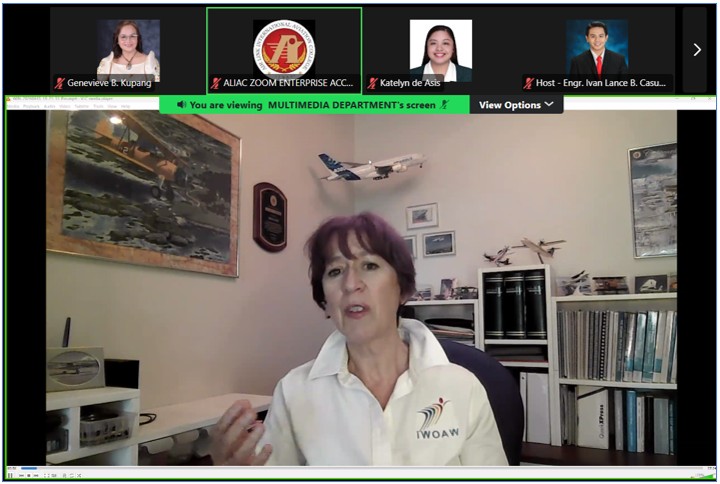
The second plenary was delivered by Mireille Goyer, Founder and CEO of the Institute for Women of Aviation Worldwide (iWOAW), who joined from Canada with a message that was both data-rich and deeply personal. Drawing on her own journey from information technology to aviation, she used her story as an invitation: embrace change rather than fear it.
Her presentation wove together three forces defining aviation’s future: artificial intelligence, sustainability, and inclusion. Diversity, she argued, is not merely a matter of fairness. It is a matter of safety, innovation, and institutional resilience. She closed by urging students to carry ethics, responsibility, and sustainability into every professional choice. The industry they are entering will be shaped by the technology they use and also by the values they bring to it.
Dr. Ma. Eugenia Yangco: AI on the Flight Deck
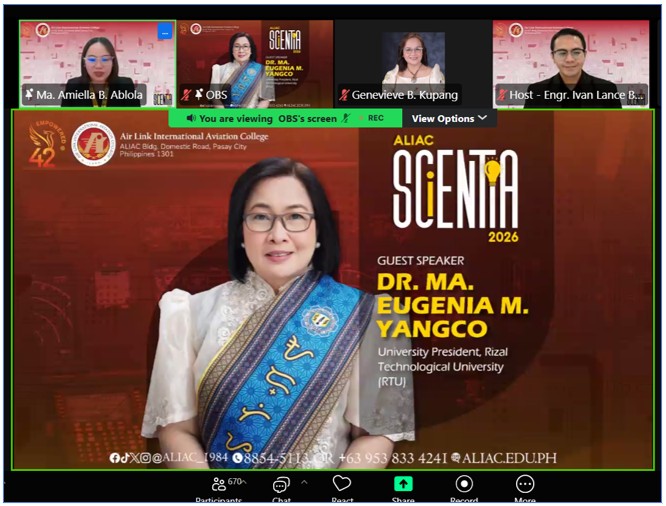
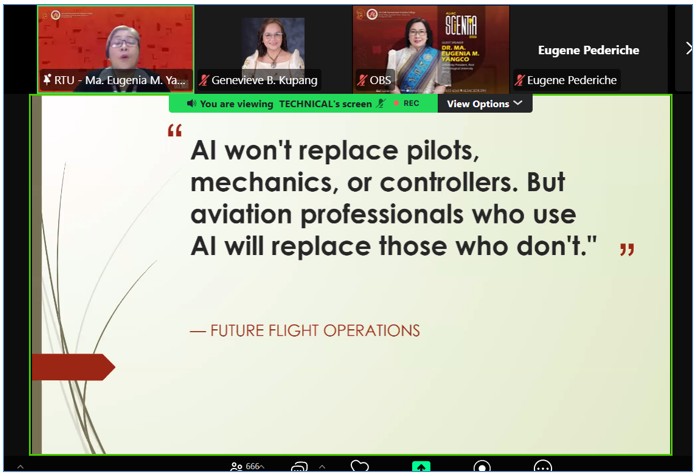
The third plenary was delivered by Dr. Ma. Eugenia M. Yangco, PhD, University President of Rizal Technological University, under the title “AI on the Flight Deck: Your New Co-Pilot,” a presentation designed to make artificial intelligence understandable, usable, and impactful for future aviation leaders. It was a talk that did exactly what its title promised.
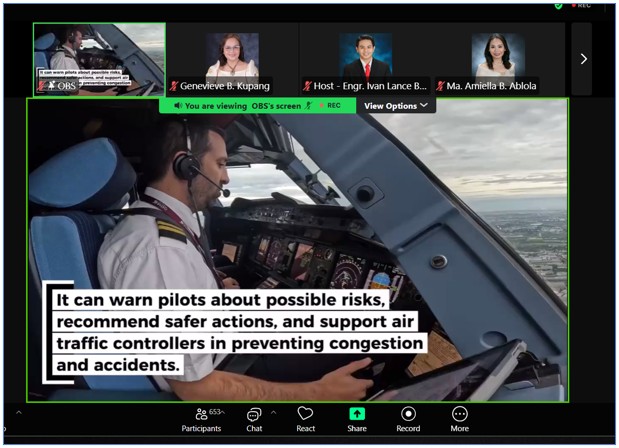
Dr. Yangco framed AI as a new kind of crew member: one that augments cockpit and cabin operations by processing data, optimizing flight trajectories, managing dynamic rosters, and handling repetitive tasks, while humans remain essential for complex decision-making, emotional intelligence, and crisis management. Where standard autopilot runs on rigid, rule-based parameters, she explained, machine learning acts like a co-pilot, gaining flight experience through millions of simulator data hours and learning dynamically from sensor records, weather patterns, and previous anomalies.
Her most pointed message was about accountability. Drawing on the aviation principle of understanding your instruments before trusting them, she argued that the same discipline must govern how professionals approach AI: understand the mechanics, cross-check references, and recognize limitations. Black-box systems in which the reasoning is hidden are dangerous in the cockpit, she warned, and they carry the same operational and ethical risks in healthcare, finance, and aviation itself. The human remains the final authority.
Dr. Genevieve B. Kupang: The Pilot in Command Is You
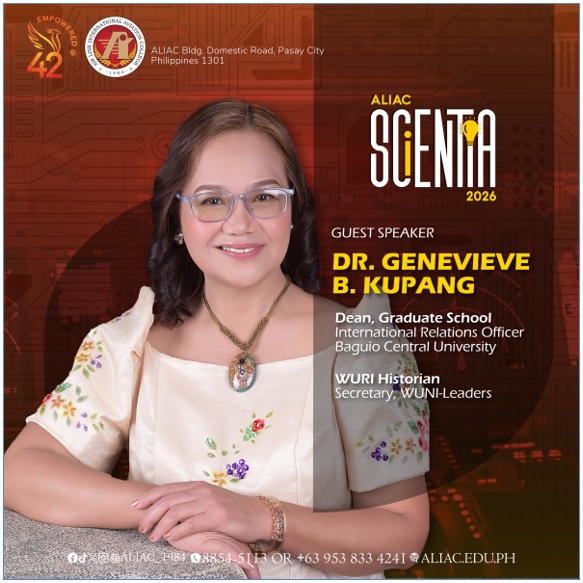
The afternoon’s motivational address was delivered by Dr. Genevieve B. Kupang, under the title “The Co-Pilot Is AI. The Pilot in Command Is You.” She opened with a story.
She spoke of Haifa, a young peacebuilder from Yemen, a country where conflict had raged for years and where speaking up could cost a woman her life. Haifa chose to speak anyway. She founded a peace initiative, brought warring factions to the table, earned a seat at the dialogue table, and held the door open for thirty other young Yemeni women to step into the peace process. She was threatened, called a foreign agent, and subjected to sustained psychological pressure meant to silence her. She did not stop.
Kupang had written an article about her. Just an article, the way she always does, because writing, she said, is how she makes sense of the world and honors the people in it. A few days later, Haifa wrote back:
“I cried while reading your article. You were talking as if you had known me for a long time, as if you had struggled with me at every stage.” She added: “Thank you for shining your light on us. It gives me the motivation to fight hard for my cause and bring peace.”
Kupang told the students: “I did not cure a disease. I did not build a bridge. I did not fly a plane. I wrote. And it reached across continents and gave someone strength to keep going.” The message that followed was direct: “Haifa did not have a runway. She built one. That is exactly what you are learning to do.”
From there, the talk moved to the scale and promise of the moment. In 2026, a record 5.2 billion passengers are expected to take to the skies ( (IATA). Global aviation revenue is projected to exceed one trillion dollars for the first time in history. The AI in aviation market, valued at USD 8.63 billion in 2025, is projected to reach USD 171.53 billion by 2033. The world is always changing. It is accelerating, and aviation is at the center of that acceleration.
But the heart of the talk was a challenge. Drawing on Ethan Mollick’s work on co-intelligence, Kupang argued that the same AI tool, in different hands, produces entirely different results. In one person’s hands: magic. In another’s: mediocrity. The tool does not determine the outcome. The professional does.
“AI will make you faster,” she told students. “Only your character will make you trustworthy. AI will give you data. Only your judgment will give that data meaning. AI will manage complexity. Only your humanity will manage the people inside the plane.”
She was clear about what sustains a career through difficulty. Speaking of Haifa again: “What sustained her was not the absence of danger. What sustained her was meaning.” That, she argued, is what carries any professional through the hardest days, long after the novelty of the first uniform fades and the technology changes again.
The session drew on BCU’s experience developing a comprehensive institutional AI policy grounded in mixed-methods research with 418 stakeholders, and on the broader global conversation on ethical AI that BCU has been contributing to through international academic networks, including WURI and WUNI-Leaders. It closed with a question and an invitation.
“Think of a time when something you said, did, or created made someone feel seen. That is your gift. That is your wing. The AI sits in the co-pilot seat. You are still the pilot in command. Now use it. Fly well. Fly purposefully. Fly with everything you are.”
A Convention Worth the Altitude
The day closed with a recap and closing remarks from Engr. Juncen Gardose, Dean of OUS, who captured the spirit of the convention in a few sincere words: Scientia 2026 was not simply a program. It was a conversation about the future, conducted by people who are serious about flying into it with both wisdom and integrity.
To the students, faculty, and guests of Air Link International Aviation College: you are training for skies that will look very different from those your predecessors navigated. Train well. Sustain your values. And always be ready to explain the choices you make.