
By: The Dean of the College of Teacher Education and Liberal Arts (CTELA)
Educational leadership goes beyond managing office transactions, attending meetings, preparing reports, and ensuring compliance with institutional policies. One of the most meaningful responsibilities of a college dean is to be directly involved in the teaching and learning process. Through walk-through observations, a dean gains firsthand insight into classroom activities, instructional practices, student engagement, and the learning environment.
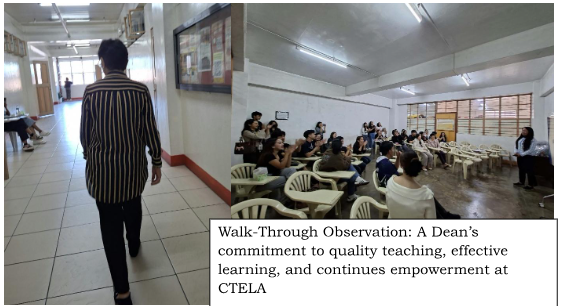
As the Dean of the College of Teacher Education and Liberal Arts (CTELA) at Baguio Central University, conducting walk-through observations is an opportunity to connect administrative leadership with the actual experiences of instructors and students. Stepping into classrooms allows the dean to see how educational goals are translated into practice and how faculty members carry out their responsibilities as educators.
Observing Teaching and Learning in Action
A walk-through observation provides a brief but valuable opportunity to observe classroom instruction. During these visits, the dean may take note of the instructor’s preparedness, teaching strategies, use of instructional materials, classroom management, and interaction with students. Equally important is observing how students participate in discussions, respond to questions, collaborate with classmates, and demonstrate understanding of the lesson.
These observations offer a glimpse into the academic life of the college. They help the dean recognize effective teaching practices while identifying areas where additional resources, mentoring, or professional development may be needed.
Walk-through observations are not simply about checking whether instructors are present or whether classes are conducted according to schedule. More importantly, they are opportunities to understand what is happening inside the classroom and how the college can continuously improve the quality of education it provides.
Leadership Through Presence and Engagement
The presence of a dean in the classroom communicates an important message: academic leadership is not confined to the office. It involves being visible, accessible, and genuinely interested in the work of faculty members and the learning experiences of students.
A classroom visit can encourage instructors to reflect on their teaching practices and remind students that their academic progress matters to the college administration. When conducted respectfully, these visits help build a culture of openness, accountability, and shared responsibility.
The dean must approach every observation with professionalism, fairness, and an open mind. Rather than immediately judging what is observed, the dean should consider the context of the lesson, the needs of the learners, and the instructional objectives being pursued. Constructive feedback and professional dialogue can transform observations into opportunities for growth.
From Observation to Improvement
The real value of a walk-through observation lies not merely in what the dean sees but in what the college does with the information gathered. Observations may reveal good practices that can be shared among faculty members, instructional challenges that require attention, and opportunities to strengthen teaching strategies.
When necessary, the dean can provide appropriate guidance, recommend relevant training, facilitate the sharing of effective practices, or coordinate with concerned offices to address instructional needs. Follow-up discussions are equally important to ensure that observations lead to meaningful improvements.
This approach supports a developmental view of instructional supervision—one that balances accountability with encouragement. Research on classroom walk-through observations in Philippine higher education likewise identifies the importance of feedback and instructional leadership in improving teaching practices.
A Commitment to Academic Excellence
For CTELA, walk-through observations can contribute to a stronger culture of quality assurance and continuous improvement. They can help align classroom practices with course learning outcomes, program objectives, institutional standards, and the college’s commitment to producing competent, ethical, and socially responsible graduates.
As the college continues to pursue academic excellence and prepare for future accreditation activities, the dean’s direct engagement with classrooms becomes especially significant. Quality assurance should not exist only in documents and reports; it should also be evident in the daily experiences of teachers and students.
Ultimately, a dean’s walk-through observation is more than a routine administrative activity. It is an expression of instructional leadership, a means of strengthening relationships, and a commitment to ensuring that meaningful learning takes place in every classroom.
A dean may lead from the office, but the true impact of academic leadership is experienced in the classroom—where teaching inspires, learning develops, and the future of education takes shape.
The article aligns with SDG 4 which promotes quality teaching and learning through the dean’s classroom walk-through observations, instructional supervision, constructive feedback, and support for faculty development to enhance student engagement and academic excellence.
Reference:
Co, A. G. E., & Soriano, R. M. (2022). Classroom walkthrough observations in a state university: On grounded theory. International Journal of Evaluation and Research in Education, 11(2), 839–847.