October 24, 2026, commemorates the 1945 ratification of the UN Charter
Authors: Marina Bid-ing, Rubenson Bilag, Cynthia Calavera, Faithfulyn Colian, Benlyn Kaye Coloma, Oscar Lacaden, Jessie Legawen, Elmer Kelly Menzi Jr., Cyrille Gaye Miranda, Jessie Ramos, Jocelyn Pilas, Cherrie Ann Pintado, and Minirva Songaben under the guidance of Professor Jose R. Balcanao, PhD.
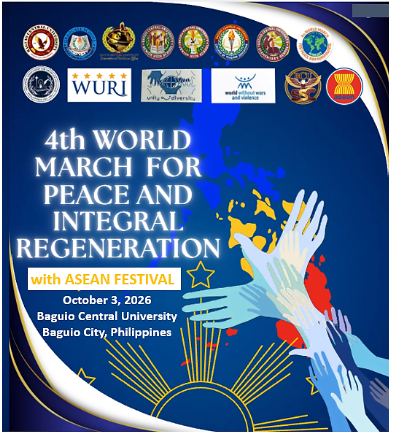
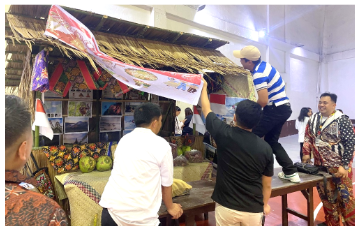
Transforming academic halls into vibrant crossroads of international solidarity and local heritage, Baguio Central University (BCU) successfully hosted the 4th World March for Peace and Integral Regeneration (4WMPIR) alongside the ASEAN Festival at the DJMF Function Hall and university gymnasium. Under the leadership of Graduate School Dean and International Relations Officer Dr. Genevieve B. Kupang, BCU joined forces with internal stakeholders and global peace allies to advance internationalization through digital connectivity and multi-sectoral cooperation. A defining highlight of the gathering was the exhibition booths prepared by graduate students, each representing an assigned ASEAN nation and showcasing country crafts, products, and cultural artifacts that brought the ideals of peace and international regeneration to life.
The immersive exhibition booths served as tangible testaments to economic resilience and sustainable innovation, championing Sustainable Development Goal (SDG) 8 (Decent Work and Economic Growth) and SDG 9 (Industry, Innovation, and Infrastructure). Central to these interactive displays was the active participation of doctoral and master’s programs.
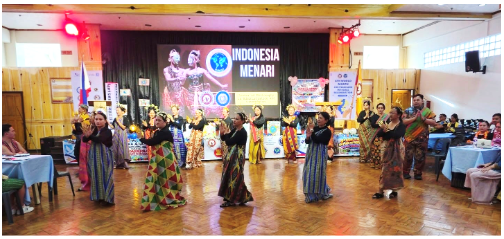
The Doctor of Philosophy in Administration and Supervision (PHAS) program featured Indonesia, presenting comprehensive exhibits focused on public policy, participatory governance, and sustainable educational administration. The PHAS showcase illuminated how decentralized administrative systems safeguard cultural heritage while driving systemic reform. By illustrating Indonesia’s regional governance models alongside traditional crafts, artistic displays, and performance art, the program championed SDG 16 (Peace, Justice, and Strong Institutions) and SDG 11 (Sustainable Cities and Communities).
Simultaneously, the Doctor of Educational Management (EdMGT) program represented Myanmar, centering its presentation on institutional rebuilding, cultural preservation, and equitable access to quality instruction. The EdMGT exhibit provided insights into post-conflict recovery and the crucial role strategic educational management plays in restoring national identity. Through detailed displays of Cambodian artistic traditions and educational reform frameworks, the EdMGT booth aligned directly with SDG 4 (Quality Education) and SDG 10 (Reduced Inequalities).
Set against Baguio City’s multicultural environment, these displays celebrated SDG 11 by fostering inclusive civic spaces where educators, civil society leaders, and international delegates exchanged insights. Furthermore, by elevating indigenous Cordilleran traditions alongside Southeast Asian heritage onto a global platform, the graduate displays addressed SDG 1 (No Poverty) and SDG 10, proving that sustainable development must amplify regional and grassroots voices.
The academic and policy discourse further anchored the mobilization on human dignity, social inclusion, and holistic well-being. The formal program opened with a “Call to Prayer Flute” performed by Sagada flutist Ms. Dom-An Florence Macagne, followed by hymns rendered by the BCU Chamber Choir under Conductor Jomard L. Calamba. Vice President for Academic Affairs Dr. Elma D. Donaal delivered the welcome remarks, emphasizing that higher education institutions must serve as sanctuaries of peace, dialogue, and ethical leadership.
Keynote speakers and local leaders reinforced the vital connection between peacebuilding and institutional development. Lone District of Baguio City Representative Hon. Atty. Mauricio G. Domogan delivered a message highlighting BCU’s core values of justitia (justice), libertas (liberty), and equitas (equity) as fundamental pillars for a just society. Congressman Domogan noted that peace endures only when equal opportunity and human dignity are accessible to all, citing Executive Order No. 570, which institutionalized peace education across Philippine schools. Complementing this, Baguio City Councilor Hon. Vladimir D. Cayabas delivered a plenary address on “Peace as an Enabler for Sustainable Development,” illustrating how civic stability, legislative integrity, and youth empowerment form the bedrock of economic progress. Together, their presentations aligned with SDG 4, SDG 5 (Gender Equality), and SDG 16.
Addressing the psychological dimensions of modern global collaboration, University of Santo Tomas faculty member and past president of the Psychological Association of the Philippines Dr. Marc Eric S. Reyes underscored the necessity of overcoming regional silos to enrich global mental health dialogues. Dr. Reyes emphasized that international research collaboration must prioritize diverse cultural narratives and regional voices outside Metro Manila to foster psychological resilience. These discussions intersected seamlessly with SDG 2 (Zero Hunger) and SDG 3 (Good Health and Well-Being), further reinforced by organic farming advocate Carmen Cabling through her presentation on the Participatory Guarantee System in Quezon and Mt. Banahaw, demonstrating how community-led sustainable agriculture enhances food security and physical wellness.
Environmental stewardship formed another critical pillar of the integral regeneration framework. Graduate research projects and plenary presentations demonstrated how campuses and local communities can champion SDG 6 (Clean Water and Sanitation), SDG 7 (Affordable and Clean Energy), and SDG 12 (Responsible Consumption and Production). By drawing upon indigenous land practices, participants linked local forest and watershed preservation in the Cordillera mountains directly to SDG 13 (Climate Action), SDG 14 (Life Below Water), and SDG 15 (Life on Land), establishing ecological harmony as an indispensable prerequisite for disaster resilience and human survival.
Vibrant cultural interludes continuously enriched the day’s proceedings. The BCU Fungakan Dancers captivated the audience with traditional ethnic dances from the Cordillera region. Additionally, College of Teacher Education and Liberal Arts (CTELA) students Rod Sanford Aticao and Styl Amando delivered a musical rendition of Tropical Depression’s “Kapayapaan,” reminding attendees that artistic expression serves as a bridge across diverse communities.
The afternoon proceedings culminated in a convergence of global partnerships and institutional commitment, actualizing SDG 16 and SDG 17 (Partnerships for the Goals). Virtual solidarity messages from international advocates reinforced cross-border alliances, including contributions from Raghu Ghimire (Nepal) on “Solidarity for Himalayan Victims: Voice of Civil Society,” Dr. Tandis Taghavi (Iran), German humanist filmmaker Luz Jahnen (inviting participants to active non-violence initiatives in Berlin), World Without Wars and Violence founder Rafael de la Rubia (Spain), and Her Excellency Constance See Sin Yuan, Ambassador Designate of Singapore to the Philippines. Complemented by insights on peace journalism from Karina Lagdameo-Santillan and Sheena Pearl L. Pangda, alongside contributions from civil society leaders, faculty, and student delegates, the event demonstrated that global peace is forged through collective action.
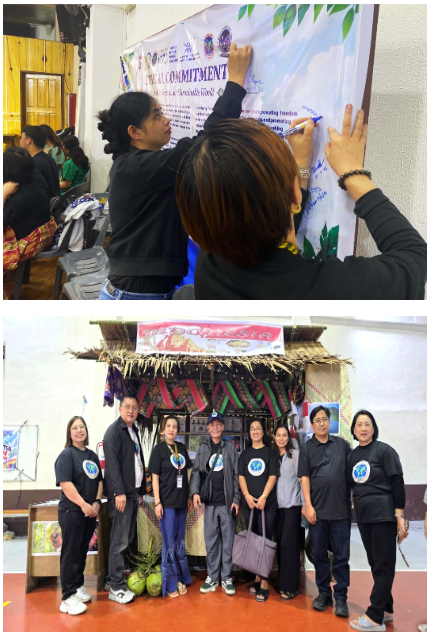
The gathering reached its ceremonial peak as organizers, dignitaries, and student leaders led the assembly in reciting and signing the solemn Ethical Commitment, pledging to utilize academic knowledge for justice, peace, and sustainable development. This was followed by the formation of a symbolic human peace sign by participants inside the university hall. Vice President for Administration Dr. Michael T. Sebullen formally closed the event with a message of gratitude.
The 4WMPIR at BCU serves as a reminder that building a peaceful world is an active, daily responsibility. By bringing together international delegates, civic leaders, educators, and students, the event demonstrated how UN SDGs are realized through localized action, open dialogue, and cross-cultural understanding. Integral regeneration challenges us to address peace holistically through social justice, mental well-being, ecological stewardship, and good governance. When equity, truth, liberty, and justice guide collective efforts, peace becomes an achievable, living reality for all.