BAGUIO CENTRAL UNIVERSITY

(074) 444-9247 / (074) 424-8216 #18 Bonifacio Street, ABCR Barangay, Baguio City
Baguio Central UniversitySoaring High Towards Excellence

THE DIGITAL FRONTIER OF PEACE: Dismantling Violence in the Age of Connection

October 3, 2026

By: Genevieve B. Kupang

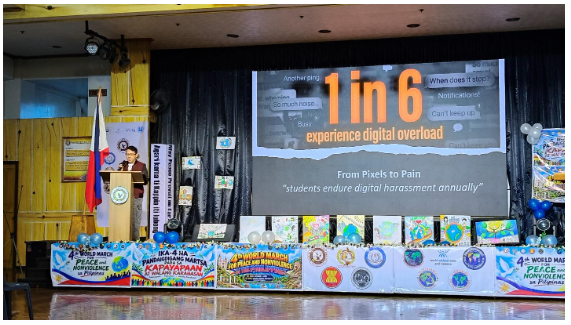
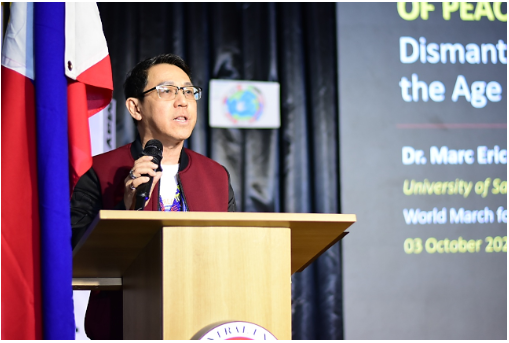
Dr. Marc Eric S. Reyes addresses delegates of the 4th World March for Peace and Integral Regeneration (4WMPIR) at Baguio Central University, emphasizing the urgent need for digital empathy and non-violence in modern online spaces. Photo credit: Erwin Escalada and Jojo Hubo

Dr. Marc Eric Reyes Keynote Address During the 4th World March for Peace and Integral Regeneration (4WMPIR) (This is the 5th series of articles regarding the 4th World March for Peace and Integral Regeneration)

Dr. Marc Eric S. Reyes was one of the keynote speakers during the 4WMPIR. He is a full-time Professor of Psychology at the University of Santo Tomas, past President of the Psychological Association of the Philippines (PAP), and the PAP’s 2026 Outstanding Psychologist. Internationally recognized for his research in suicidology, social media use, and mental health advocacy, he serves on multiple American Psychological Association (APA) boards and was awarded an APA Presidential Citation in 2022 for his leadership and global dedication to psychology.

A Warm Welcome to Peace Partners: Dr. Michael T. Sebullen, Vice President for Administration, warmly greets visiting peace partners from Manila, including University of Santo Tomas (UST) professor and guest resource speaker Dr. Marc Eric S. Reyes. The handshakes and exchanges set a collaborative and welcoming tone for the peace gathering.
Connecting our roots to the digital frontier. The Fungakan Dancers grace the stage at the 4th World March for Peace and Integral Regeneration (4WMPIR). As we navigate "The Digital Frontier of Peace: Dismantling Violence in the Age of Connection," indigenous performers remind us that authentic unity begins with cultural heritage and community spirit.

The Digital Frontier of Peace: Dismantling Violence in the Age of Connection 

The line separating physical existence from digital life has blurred in this era of hyperconnectivity. While technology offers opportunities for cross-border collaboration and connection, it has simultaneously opened a new front for systemic harm and violence.

Addressing this crisis, Dr. Marc Eric S. Reyes delivered a plenary address titled “The Digital Frontier of Peace: Dismantling Violence in the Age of Connection.”

Dr. Reyes is a full-time Professor of Psychology at the University of Santo Tomas (UST), past President of the Psychological Association of the Philippines (PAP), and PAP’s 2026 Outstanding Psychologist. In his address, he presented an analysis of cyberbullying, reframing online harassment beyond a schoolyard issue and grounding it as a fundamental human rights violation and a barrier to global peacebuilding.

The Paradox of Connection and the New Frontier of Violence

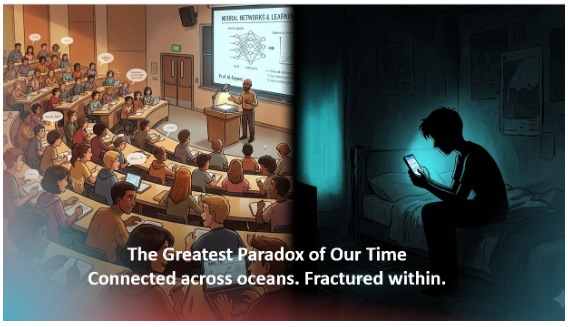
Drawing on his dual expertise inside university lecture halls and therapy rooms, Dr. Reyes highlighted the central paradox confronting today’s youth. Despite belonging to the most connected generation in human history, young people are experiencing a global epidemic of emotional trauma, anxiety, and isolation.

Traditional peace movements have historically focused on ending state-level physical conflicts, nuclear proliferation, and street violence. However, Dr. Reyes emphasized that non-violence must be redefined for the 21st century to encompass digital empathy. When individuals are mocked, systematically humiliated, or isolated online, their fundamental rights to dignity and mental well-being are directly violated.

“Digital violence is real violence. The very tools built to bring us together are being weaponized to tear our youth apart.” — Dr. Marc Eric S. Reyes

Redefining the Battleground: Anonymity and Algorithmic Multipliers

As a scholar whose research focuses on suicidology, social media use, and LGBTQ+ psychology, Dr. Reyes provided a breakdown of how digital harassment differs structurally from physical aggression.

Bullying was historically bounded by time and geography. The school bell signaled relief, and the home provided a sanctuary. Cyberbullying, by contrast, operates around the clock, tracking individuals into their living spaces and bedrooms.

Online platforms are non-neutral spaces. They utilize algorithms optimized to capture human attention through division, outrage, and cruelty. This creates a multiplier effect where malicious posts, rumors, or unconsented photos are permanently archived, repeatedly shared, and magnified into continuous trauma.

Physical confrontations present immediate physical cues, such as tears or flinching, that trigger natural human empathy and signal an aggressor to stop. The anonymity and detachment of a glass screen remove these natural psychological barriers. This enables perpetrators to strike without confronting the human cost of their actions.

Cultural Expression as a Catalyst for Peace. The male Fungakan Dancers highlight how living traditions and cultural arts foster the empathy, harmony, and solidarity needed to build a more peaceful world.

The Psychological Toll: From Pixels to Real-World Pain

The clinical impacts of online hostility extend far beyond virtual environments. Global data indicates that nearly one in six students experiences cyberbullying every year, with marginalized and vulnerable groups suffering disproportionately.

Within therapy environments, this continuous psychological pressure translates into clinical depression, chronic anxiety, psychosomatic illnesses, and elevated rates of self-harm and suicidal ideation. Dr. Reyes noted that digital harm regularly manifests in physical environments as academic decline, relational breakdowns, and retaliatory aggression. True global peace cannot be achieved while the psychological well-being of future generations is systematically undermined online.

A Blueprint for Digital Peacebuilding

To counteract the rise of digital hostility, Dr. Reyes outlined an action plan targeting students, educators, and policy-makers.

First, students as active digital defenders must take personal responsibility for their online conduct and reject the economy of outrage. Silence or passive laughter in the face of online abuse functions as a vote for violence. Youth must transition from passive bystanders to active digital defenders by reporting predatory content, publicly offering supportive narratives, and privately validating victims to interrupt cycles of harm.

Second, educational institutions must expand digital literacy beyond technical skills like coding. Pedagogy needs to integrate instruction on digital citizenship and cyber-hygiene. Educators must build empathetic environments where emotional intelligence is prioritized alongside academic metrics, ensuring students have allies when facing online harassment.

Third, addressing digital harassment requires systemic regulation of tech platforms. Just as industrial corporations are held accountable for environmental pollution, tech conglomerates must be held responsible for polluting digital environments. Governments need to enforce legislative frameworks protecting citizens online, while tech developers must be compelled to transition from profit-driven outrage models to safety-by-design algorithmic frameworks.

Reclaiming Devices as Instruments of Peace

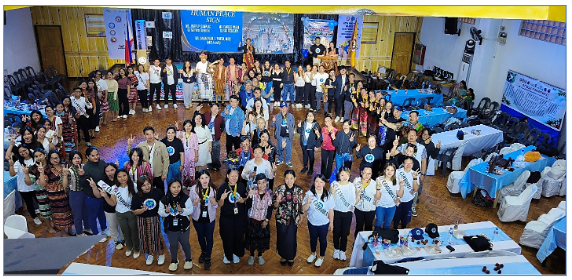
The Human Peace Sign to Bridging Connections for Global Peace: Event participants, organizers, and delegates raise peace signs following Dr. Marc Eric S. Reyes’s talk on "The Digital Frontier of Peace," demonstrating the power of unity and nonviolence in an interconnected world.

Dr. Reyes concluded his plenary address with a call to action, reminding audiences that typed words carry real psychological weight. Peace is an active, daily practice reflected in personal communication choices and online interactions rather than a theoretical framework reserved for international treaties or summits.

By consciously demilitarizing digital communication, comment sections can be converted into spaces of human dignity, and personal devices can be transformed into tools for peace.

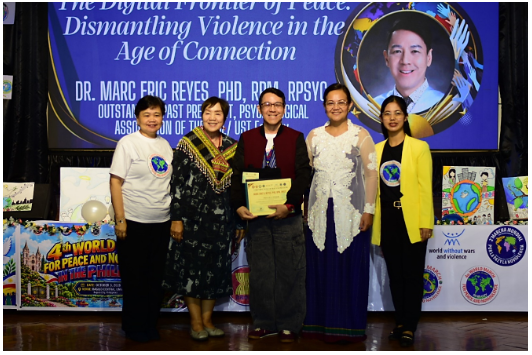
Dr. Marc Eric S. Reyes (PhD, RPM, RPsych) is joined by key university leaders: Dr. Elma D. Donaal (VP for Academic Affairs), Mrs. Amalia F. Ancheta (VP for Finance), Dr. Genevieve B. Kupang (Dean of the Graduate School), and Dr. Shamany Lokines (GS MPA Professor), following his inspiring presentation on "The Digital Frontier of Peace: Dismantling Violence in the Age of Connection.
From left to right (front row): Keynote speakers Dr. Ramir Austria (PAGE-CAR President), Dr. Marc Eric Reyes, past president of the Psychological Association of the Philippines and UST Faculty; Manila-based peace advocates Fortune Bucud, Jojo Hubo, and Erwin Escalada. (Back): GS Faculty members Dr. Altea Ramos, Dr. Jose R. Balcanao, and Dr. Michael De Roxas, together with Philip and Adelaida Guia, and student participants. Photo Credit: Jojo Hubo, Erwin Escalada, Dr. Altea Ramos, and Dr. Loida Mangangey

About the Author:

Genevieve B. Kupang, PhD, is the Dean of the Graduate School and the International Relations Officer of Baguio Central University. She is the lead organizer of the 4th World March for Peace and Integral Regeneration, having invited government units, the Philippine Association of Graduate Education, the World Council for Curriculum and Instruction, the Community for Human Development, the World University Network of Innovation Leaders (WUNI-L), World without Wars, Berlin 2027, Participatory Guarantee System Quezon, Pressenza, Singapore Embassy in the Philippines, the City Council of Baguio City, the Representative of the lone district of Baguio City, the Graduate School of Baguio Central University, the Basic Education Unit of BCU, student leaders, and its heads of offices.