BAGUIO CENTRAL UNIVERSITY

(074) 444-9247 / (074) 424-8216 #18 Bonifacio Street, ABCR Barangay, Baguio City
Baguio Central UniversitySoaring High Towards Excellence

Elevating Education Through Inquiry: BCU Graduate School Propels Community Impact, Global Goals, and Research Leadership

Authored by: Genevieve B. Kupang, Dean, Graduate School

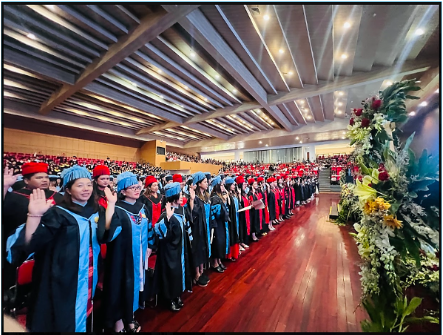
BCU Graduating Class of 2025–2026. BCU advanced degree graduates pledge their loyalty to the University, vowing to harness the knowledge gained from their master's theses and dissertations to drive positive societal impact. (Credit To The Owner)

1.Expanding Educational Horizons Through Grassroots Scholarship

Baguio Central University Graduate School inquiry stands as a bridge connecting theoretical rigor with practical community empowerment. At BCU, advanced scholarship is designed to fulfill degree requirements and serve as an engine for localized educational progress. During Academic Year 2025–2026, the Graduate School produced master’s theses across early childhood and elementary education, representing a milestone in evidence-based pedagogical reform.

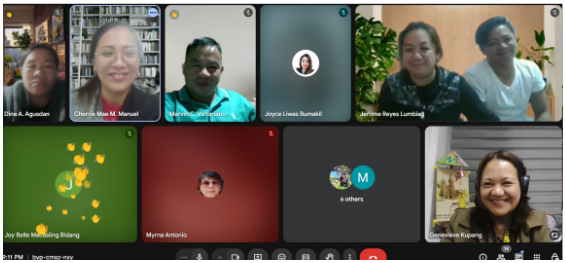
Collaborative Graduate Instruction. Dr. Cherrie Mae M. Manuel and Dr. Genevieve B. Kupang team-teach Qualitative Methods of Research to BCU graduate students. Dr. Kupang facilitated an in-depth discussion focusing on ethnography and phenomenology as key qualitative research designs.

These studies demonstrate how graduate studies directly support nation-building ideals. By translating high-level academic frameworks into action-oriented classroom tools, graduate student researchers have addressed persistent learning gaps, elevated instructional leadership, and created tangible benefits for regional basic education. This body of work underscores Baguio Central University’s commitment to providing quality, transformative, and accessible higher education.

  1. Strategic Alignment: The R.E.S.E.A.R.C.H. Framework and Institutional Vision

The fifty-three masteral manuscripts completed during Academic Year 2025–2026, comprising fifty-one titles in Elementary Education and two titles in Pre-Elementary Education, embody a deliberate, institutional alignment with the university’s five-year strategic roadmap and overarching research agenda. Under the strategic direction of the Graduate School leadership Dr. Genevieve B. Kupang, and Dr. Edna Culbongan, GS Research Coordinator, and the Research & Development Center, these studies operationalize key result areas centered on academic excellence, research innovation, and community extension.

Every study produced this year reflects the core tenets of the university’s acronymic research philosophy:

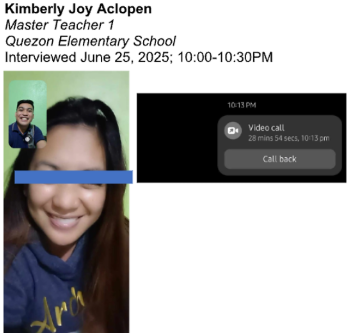
Dr. Michael T. Sebullen interviews Ms. Kimberly Joy Aclopen (Master Teacher I, Quezon Elementary School) on June 25, 2025, assisting researcher Cristobal Agpad and adviser Dr. Genevieve B. Kupang in gathering qualitative data on reciprocal teaching for learners with special needs.

Through this unified framework, student researchers activated two primary agenda clusters: the SINAG cluster (Scholarly Inquiry and Nationally-Aligned Advanced Graduate Research) and the TANGLAW framework (Teaching and Advancement of Nurturing Global Learners through Arts and Writing). While SINAG provided the macro-level policy orientation and interdisciplinary grounding, TANGLAW focused directly on early childhood literacy, foundational numeracy, contextualized learning materials, and home-school partnerships.

  1. Policy Integration: National Standards and Sustainable Development Goals

The academic endeavors of the 2025–2026 graduate cohort mirror the governance standards set by the Commission on Higher Education, fulfilling the requirements of Policy Memorandum Order Number 15, Series of 2019, alongside updated guidelines CMO21 under Series of 2025. By maintaining standards of inquiry and requiring public research dissemination or peer-reviewed publication acceptance, the Graduate School ensures that its scholars contribute meaningful knowledge to the broader academic community.

On the national level, these classroom-based investigations contribute to the social transformation goals outlined in NEDA’s AmBisyon Natin 2040. Specifically, they advance the pillars of Malasakit (strengthening the social fabric through supportive learning environments) and Pagbabago (reducing inequality through accessible, high-quality instruction). At the regional level, the research findings provide practical insights that support the Cordillera Regional Development Plan.

Furthermore, this scholarship aligns directly with the United Nations Sustainable Development Goals. The studies primarily advance SDG 4 (Quality Education) by developing targeted interventions in reading, mathematics, and special needs education. This was done by fostering robust collaboration between teachers, parents, school administrators, and civic leaders; these efforts fulfill SDG17 (Partnerships for the Goals).

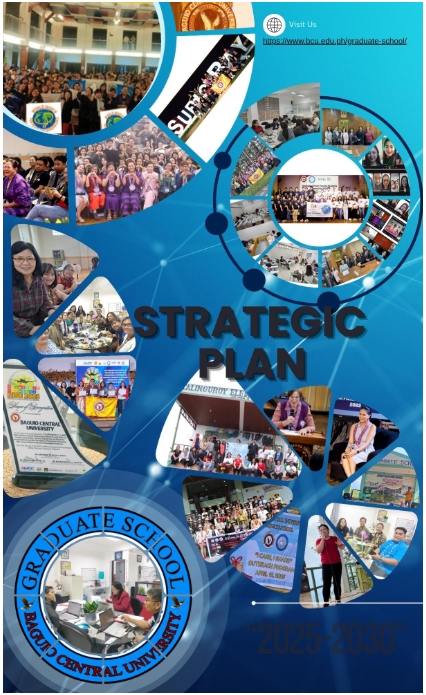
Strategic Roadmap: The Baguio Central University Graduate School Strategic Plan (2025–2030) guiding institutional research and community development initiatives. Design: Christian Charles E. Baguingey and Genevieve B Kupang
  1. Structural Rigor, Ethics, and Institutional Compliance

Scholarship at is built upon adherence to institutional research standards, formatting guidelines, and ethical protocols. Masteral candidates’ complete coursework across core disciplines and pass comprehensive examinations, and engage in community extension service before proceeding to thesis proposal and defense stages.

Research ethics remain paramount throughout the inquiry process. Scholars observe the Data Privacy Act of 2012, obtain formal informed consent from all respondents and/or participants, and maintain transparency regarding technological tools through institutional artificial intelligence disclosure protocols. 

In terms of manuscript structure and presentation, candidates adhere to the American Psychological Association (APA 7th Edition) format. Within Chapter 3 (Results and Discussion), researchers utilize the structured Discussion-Implication-Corroboration (DIC) model, ensuring that empirical findings are analyzed, linked to practical educational applications, and validated against existing scholarly literature. Following successful oral defenses, bound manuscripts are archived in the university library repository and submitted to CHED-CAR.

Fulfilling CHED Publication Standards: Graduate School faculty member Dr. Lourdes G. Eguia with Master of Arts in Education (Major in Filipino) scholars following a mentoring session on digital research dissemination and online publication compliance.
  1. Thematic Highlights of Masteral Inquiries

The research contributions of Academic Year 2025–2026 cover a rich diversity of educational challenges, reflecting the complex realities of modern classrooms. These studies offer concrete, actionable solutions across key instructional areas:

Foundational Literacy and Language Acquisition

A substantial portion of the graduate inquiries focused on early literacy, decoding, and vocabulary expansion. Scholars investigated innovative pedagogical approaches, including digital story creation, big book interventions, recipe-based reading tasks, explicit phonics instruction, and contextualized activity sheets. These studies demonstrate how multimedia tools and culturally responsive materials enhance reading comprehension and learner engagement in primary grades.

Mathematics and Problem-Solving Innovations

Addressing mathematical learning gaps was another central focus of the cohort. Masteral researchers examined scaffolded problem-solving models, skip-counting visual number lines, web-based mathematics toolkits, tactile learning manipulatives, and the Concrete-Representational-Abstract (CRA) approach. Findings emphasize that hands-on, multi-sensory experiences help elementary learners overcome math anxiety and build strong foundational numeracy skills.

Inclusive Education and Special Needs Support

Reflecting a deep commitment to educational equity, several studies explored inclusive classroom practices. Research highlighted the lived experiences of educators using reciprocal teaching for learners with special needs, the application of Picture Exchange Communication Systems (PECS), pull-out support models, and fine motor skill development through arts activities. These inquiries provide valuable insights for building supportive, adaptive learning environments.

School Climate, Governance, and Community Partnerships

Recognizing that classroom success depends on broader structural support, graduate scholars analyzed teacher observation systems, classroom reward policies, parental perspectives on blended learning, and school readiness assessments. The findings confirm that strong alignment between home and school environments directly fosters student self-awareness, motivation, and academic resilience.

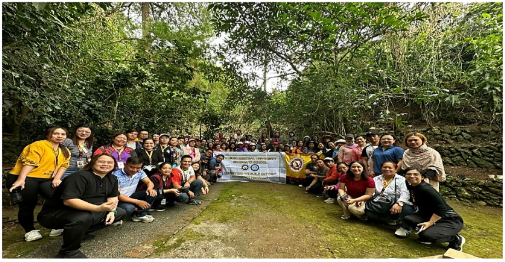
Representative of the BCU Graduate School Students and Faculty during their Community Extension Services Engagement. With them are the GS CES Coordinator Dr. Jennifer Longchasen, GS Faculty Dr. Loida Mangangey, Dr. Josephine Aguirre, and Dr. Michael De Roxas, and supported by Dean Genevieve B. Kupang and VPAA Elma D. Donaal
  1. Honoring Perseverance, Grit, and Wisdom

Behind each completed manuscript lies a narrative of dedication. Most graduate scholars in this cohort are full-time educators who balanced demanding teaching responsibilities, school administration, and family commitments while completing scholarly work. The Graduate School faculty and university administration express their deepest appreciation for this outstanding perseverance.

As Baguio Central University continues to expand its graduate research footprint, the achievements of Academic Year 2025–2026 demonstrate the power of academic inquiry. By grounding research in community needs, national priorities, and global goals, BCU scholars are advancing knowledge. The active building of an inclusive, progressive, and literate present and future society is a shared responsibility, one that advances the UN SDGs by promoting quality education (SDG 4), reducing inequalities (SDG 10), and fostering impactful partnerships for sustainable global development (SDG 17).

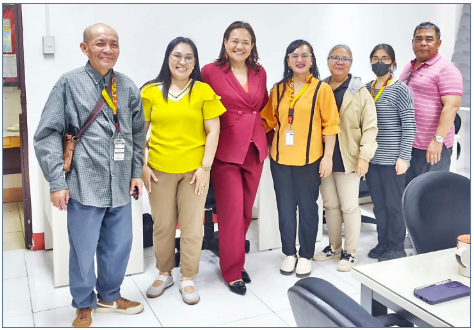
Doctoral candidate Shyla Tugay-an (in orange) celebrates her approved dissertation proposal on public school teacher leadership alongside her panel and adviser: (L–R) Dr. Jose Balcanao, Dr. Altea Ramos, Dr. Genevieve Kupang, Dr. Lillian Pagulongan, Dr. Lyha Fias-ilon, and Dr. Manion Alcantara.

#BCUSoarsHigher

#BCUGraduateSchoolSoarsHigher

#InternationalRelationsOfficeSoarsHigher

#BCUResearchProductivityandImpact

#SDG4, #SDG10, and SDG17